A brief history of University Challenge
University Challenge is one of the UK's most popular and famous TV quiz shows with a reputation for the difficulty of its questions matched only by Mastermind. The show was first broadcast on Friday 21st September, 1962 (the first match was between Leeds and Reading), filmed by Granada Television at its studios in Manchester, and with Bamber Gascoigne as its inscrutable host. It was originally based on an American show called College Bowl invented by Don Reid that began in 1959.
The early years saw Barrie Heads as producer and Peter Plummer as director, though Douglas Terry and Peter Mullings took over in the mid 1960s as producer and director respectively, retaining the positions through the 1970s. The show had been a perennial favourite, drawing up to 20 million viewers at its peak, and special shows pitting the series champions against a team of their professors were a Christmas staple, but during the 1980s ratings fell and some ITV regions threatened to stop showing the programme altogether. In 1987, after 25 years and around 970 episodes, the show was cancelled.
Seven years later, however, the show was back, but as a complete reboot; it was given a new host (in the form of Jeremy Paxman), a new set, a new format and it was moved from ITV to BBC2. Some aspects were retained, of course; questions would still begin with a "starter for ten, no conferring", followed by bonuses for the team, and questions would be as difficult as ever. The show's unchanging rules have been credited as part of its enduring success and it remains one of BBC2's most popular shows now in its seventh decade.
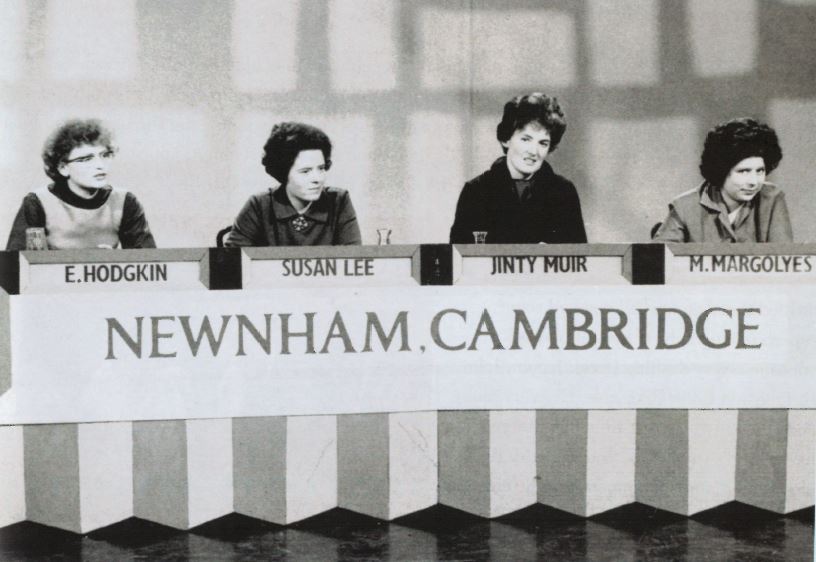
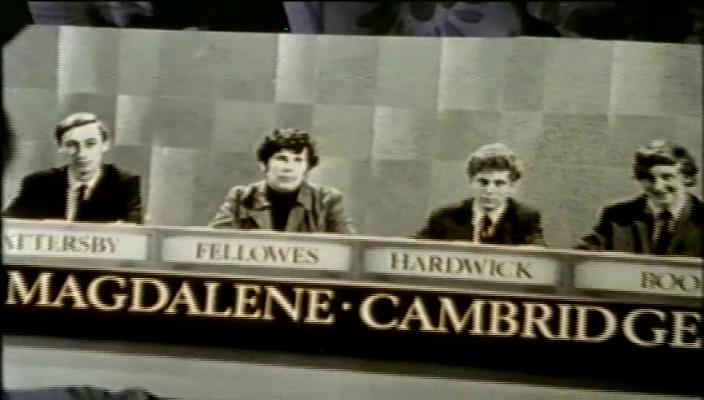
Over the years the show has been a reflection of student life and a testament to the intelligence of its youth. Notable contestants who have appeared on the show include Stephen Fry (1980), David Mellor, Malcolm Rifkind (67), David Starkey, Clive James (68), David Aaronovitch (75), Miriam Margolyes (62), Sebastian Faulks (72), Julian Fellowes (69) and John Simpson (65). If Wikipedia is to be judged as a measure of such things then the number of former contestants who went on to achieve notability approaches three figures and include a national head of state, a Chancellor of the Exchequer, a Lord Chancellor, and an Academy Award winner.



Series format
From the show's inception in 1962 until the 1984 series, the format remained unchanged. Two teams would play a match after which the loser would be eliminated and the winner would return the following week. If a team won three times then they would qualify for the quarter finals. The series continued until there were eight teams that had qualified, after which quarter-finals and semi-finals took place in which the winners would progress. The final was a 'best-of-three' match, with the first team to win two games crowned series champions. (The one exception to this was the first series in which the quarter-finals and semi-finals were also 'best-of-three'.) This format meant that each series would have an unpredictable number of games, ranging from 36 in 1976-7 to 62 for the first two series. In most years there would be around 30-35 first round games, fitting with the show's schedule of running from autumn until the following summer, and so in some years if there were still not 8 qualifiers by around 30 games then the quarter-finals would start with fewer than 8 teams and one or more teams would get a bye to the semi-finals.
This all changed in 1986 when, in an attempt to combat falling ratings, an experimental format was introduced. With the shows running Monday to Friday, each week consisted of five shows in which two pairs of teams would play each other twice. The first would use the conventional scoring system, and the second used a new 'head-to-head' system, with the scores starting from the previous day's result. The head-to-head shows featured 'pass the baton' in which a stick with six lights would start with the contestant on the left of each team. The contestant from the team losing at that point would pick from a large set of categories and Bamber would ask questions on the buzzer from that category to the two contestants with the baton. The first player to answer two would earn 15 points. After a contestant had faced two rounds the baton would move on to the next player. When a team had six right, and thus light up the whole baton, they would receive a further 15 points and get a standard set of three 5-point bonuses for their team and the lights would reset. The winners from the two pairs of games would then play each other in a single knockout game to decide who would go through to the quarter-finals. The highest-scoring team, calculated as the average score over its two or three games, qualified for the quarter-finals, as did the winner of a game between the next two highest-scoring teams that were not already through. From the quarter-finals, the format was the traditional one. This format was again used in 1987.
When the show returned in 1994, 24 teams competed for 16 second round spots, which consisted of the 12 first round winners plus the four highest-scoring losers. From the second round, the competition continued as a straight knockout.
The format was changed slightly for the 1998-9 series, in which there were 28 teams in the first round. The second round comprised the 14 winners plus two others. The four highest-scoring losers played each other in two games, with the winner of each taking the final two places in the second round. The tournament then continued as a knockout as before.
This continued until the 2009-10 series. Since then, the 28 teams are reduced to 8 in the quarter finals as before, retaining the two highest-scoring losers games. However, the quarter-finals consist of ten shows in which all teams keep playing until they either win twice (in which case they go through to the semi-finals) or lose twice (in which case they're out). The semi-finals and final are a knockout as before. This format has remained unchanged since.
Theme tune
The famous theme tune hasn't changed since Bamber's days, though has been brought somewhat up to date. Entitled 'College Boy' and composed by Derek New, a new arrangement was used for the series 1995-2000 inclusive, before being replaced with a version played by string quartet, Balanescu Quartet, that has been in use ever since.
Set
| 1962-1965 The show's first two series featured a backdrop with a rectangular pattern, an angled desk, and shaded desk markings to give the illusion of relief. | 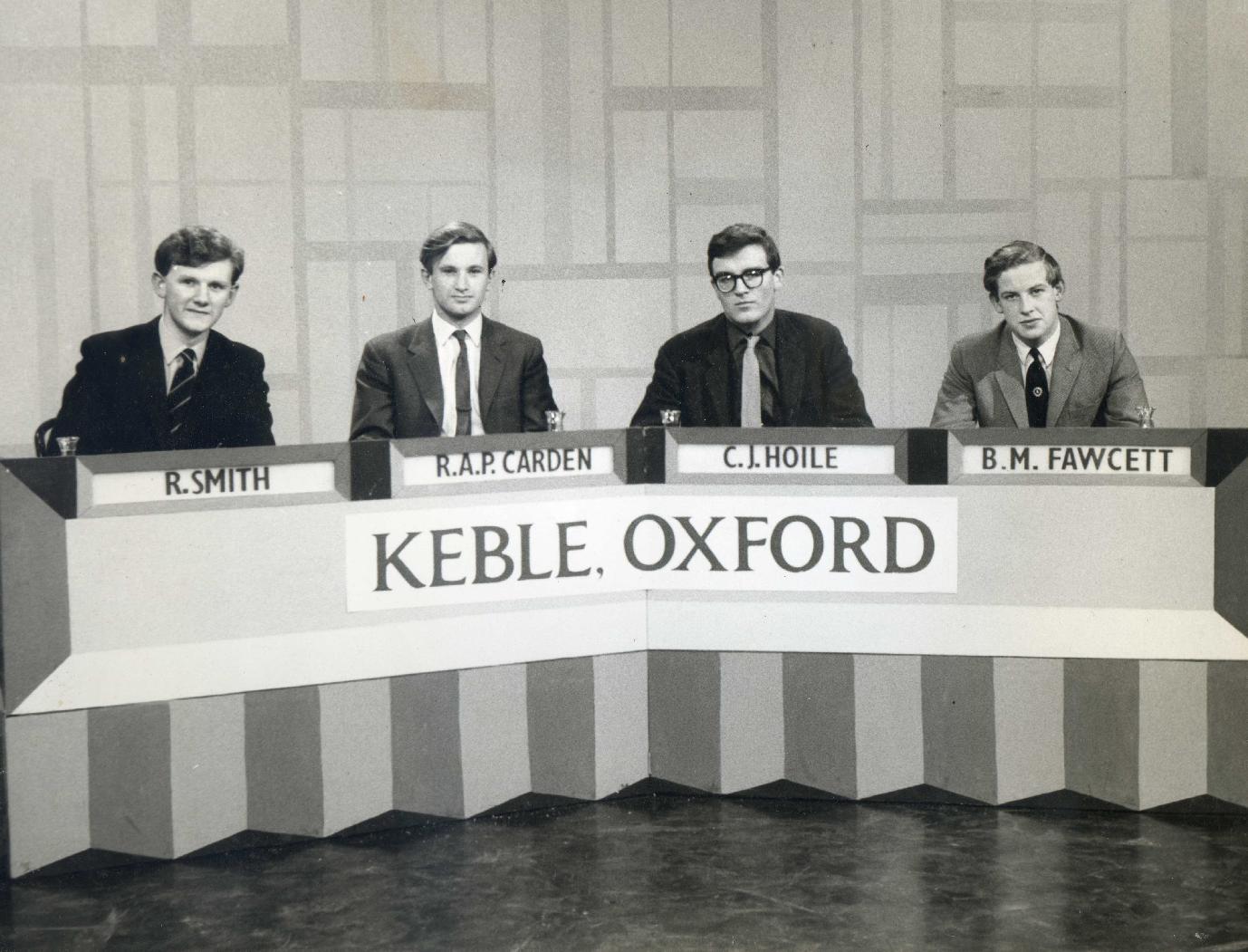 |
| 1965-1968 From 1965 the angular desk and markings had gone, replaced by a plain white desk and simpler rectangular backdrop. | 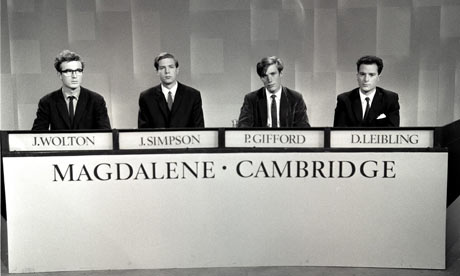 |
| 1968-1979 From series 6, contestants were no longer given an initial on their name plates, the desk was redesigned, and the rectangular pattern changed again, becoming the show's longest-lasting set. | 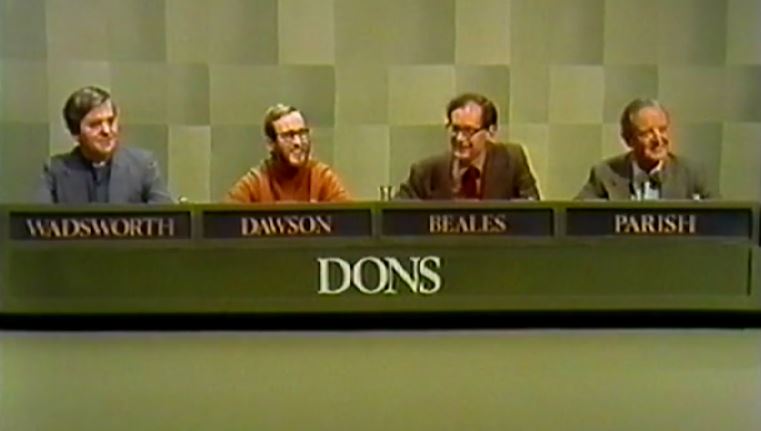 |
| 1979-1984 In 1979 the set changed only slightly. The backdrop remained unchanged but team name on the front of the desk moved to the left-hand half of the desk, with the right half given to a display showing the team's current score. | 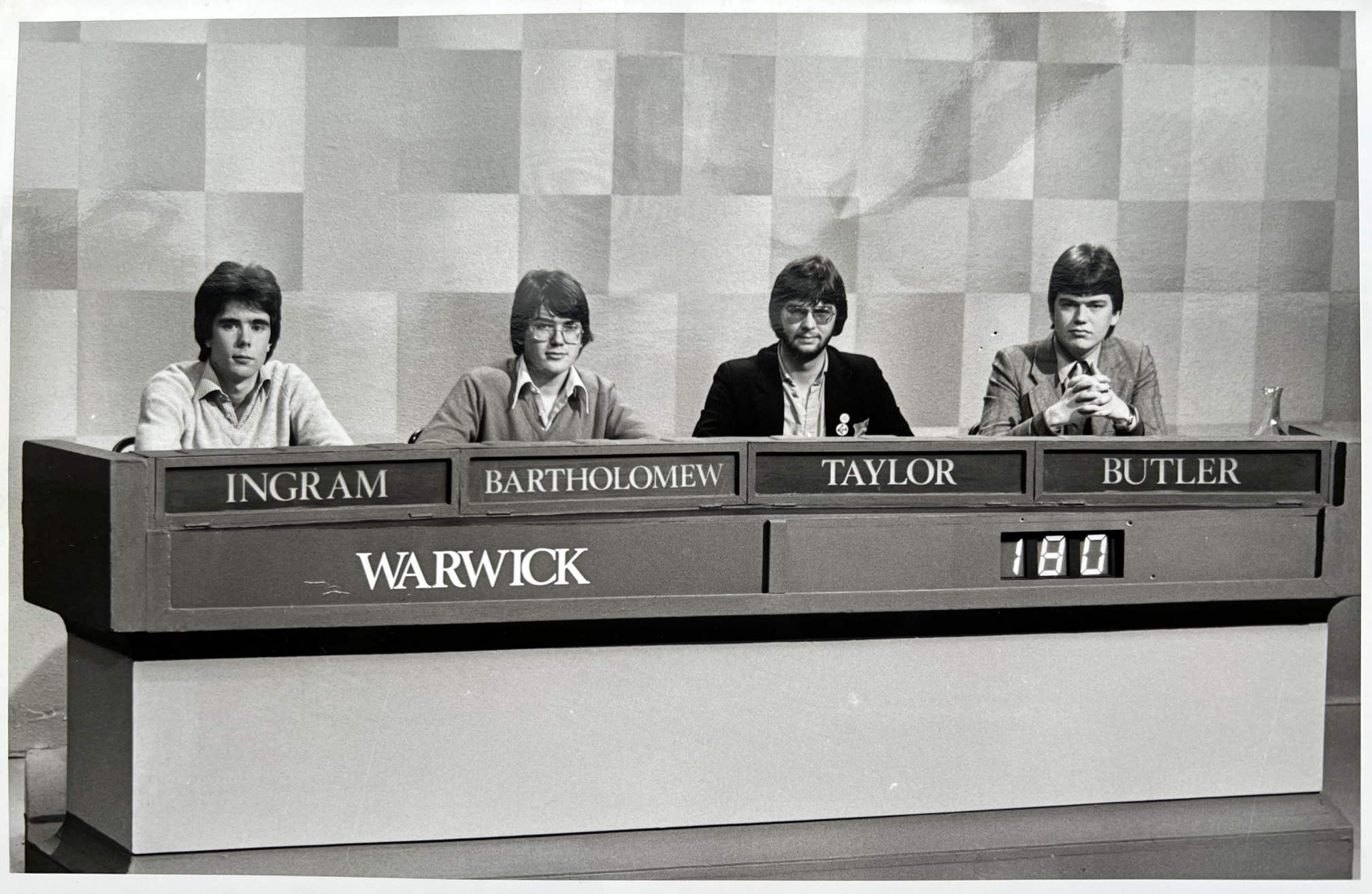 |
| 1986 The experimental format of the 1986 series featured a two-tier set with, for the first time, one of the teams actually positioned above the other. | 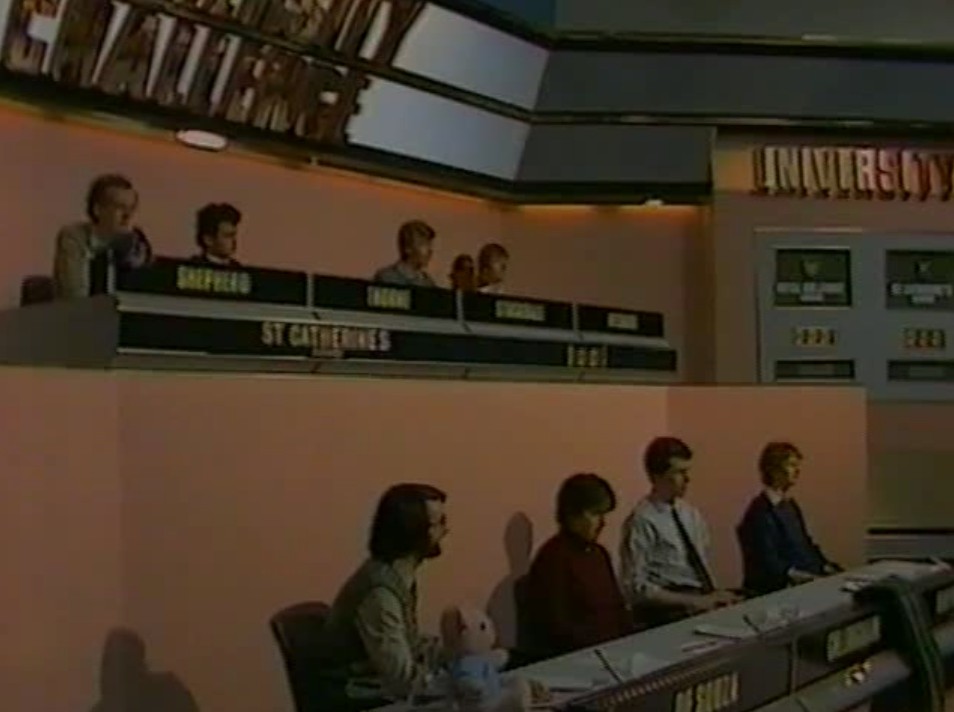 |
| 1987 The two-tier format was quickly abandoned for the final Bamber Gascoigne series, moving to a brown-themed set. | 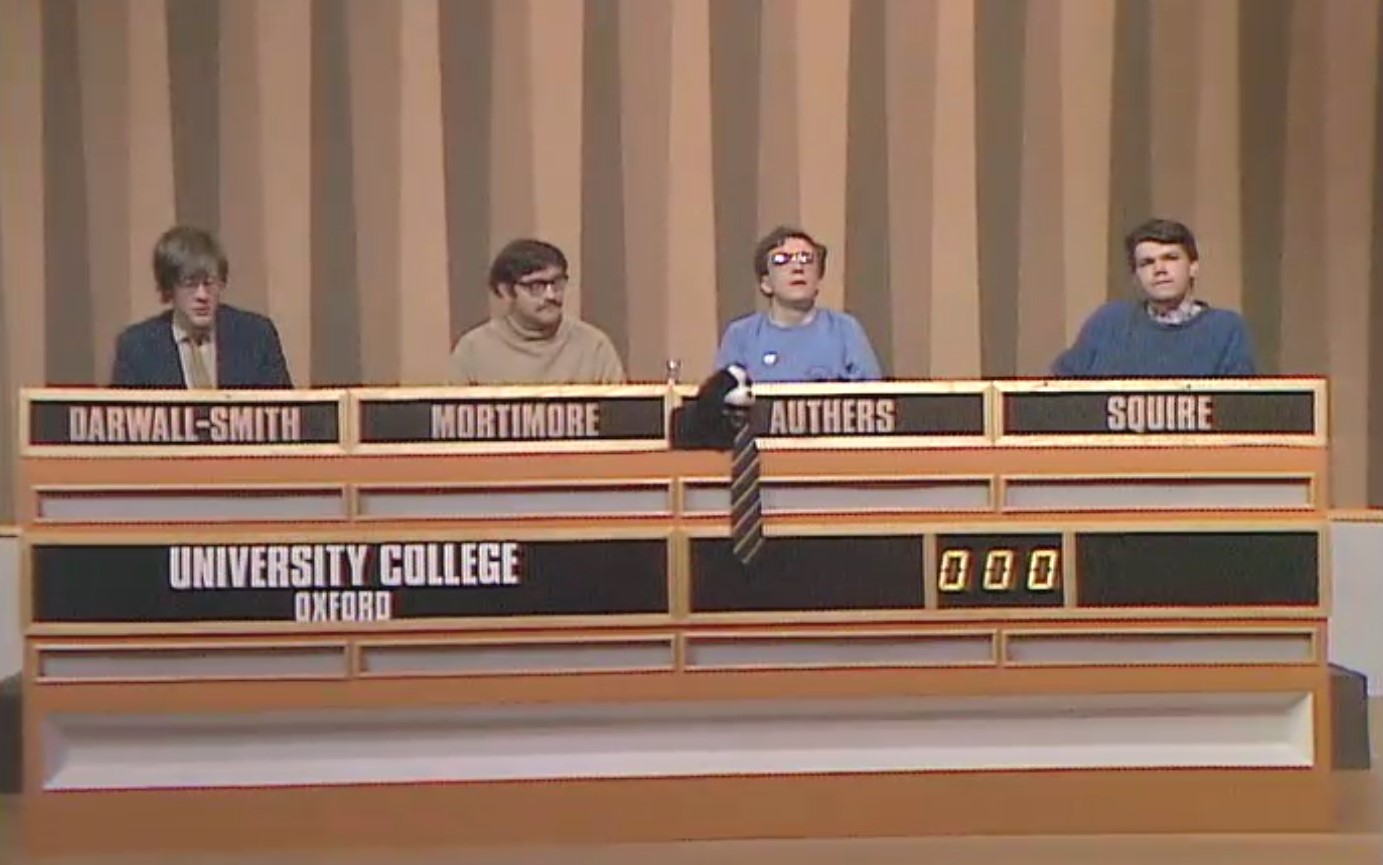 |
| 1994-2000 The BBC era began with a blue backdrop and a design showing the same etchings as the trophy. | 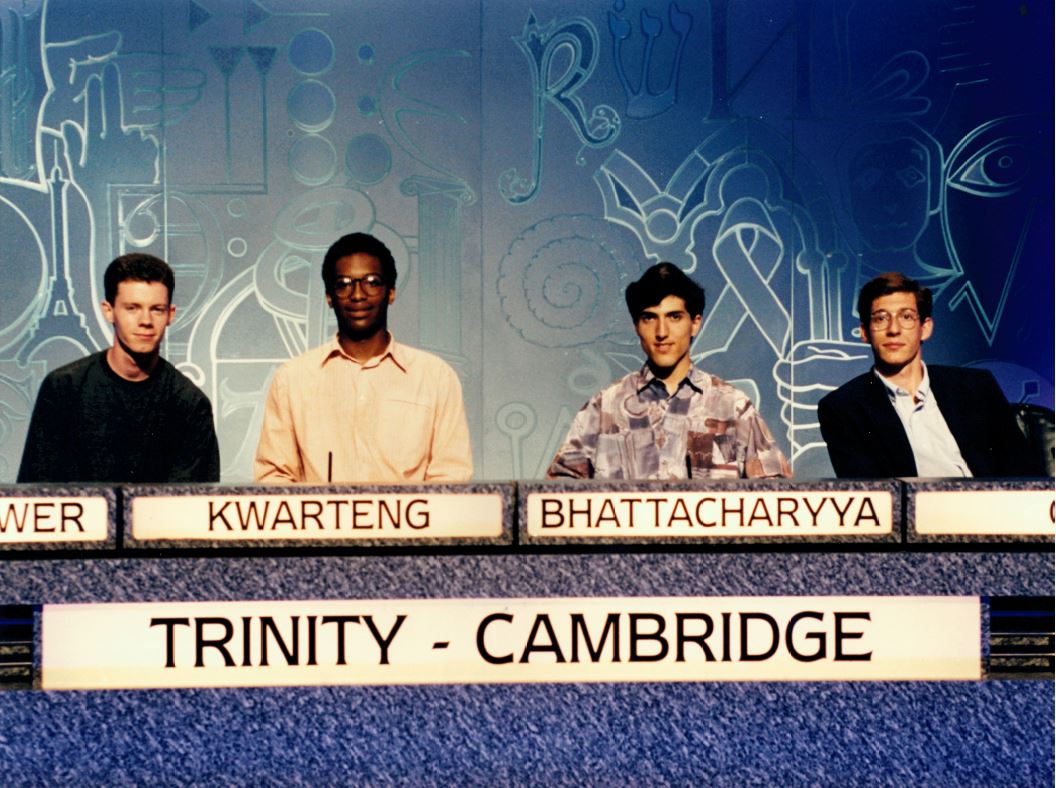 |
| 2000-2004 For the 2000-1 series the familiar blue set was replaced by a deep red backdrop illuminated by projected animated text. | 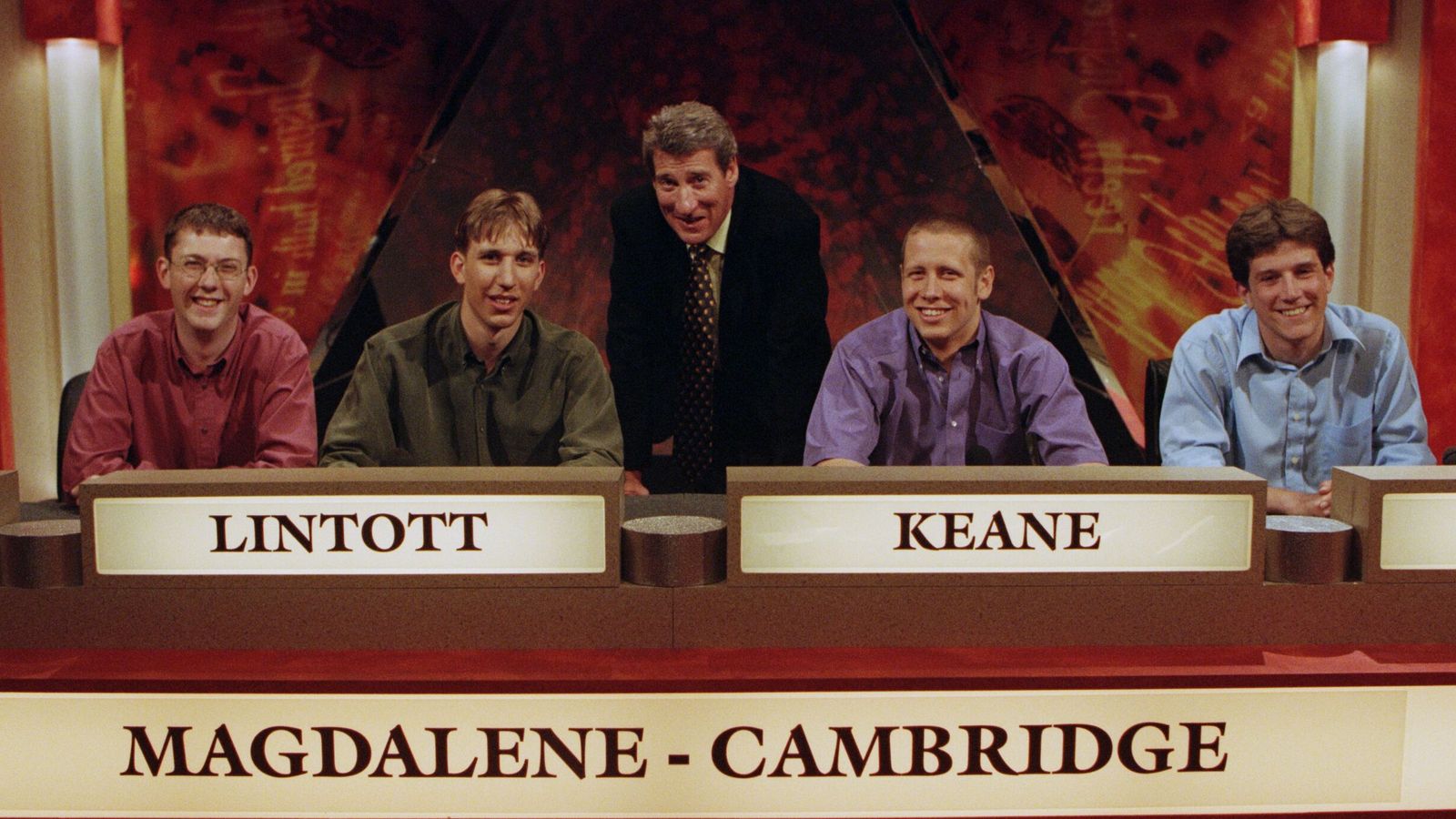 |
| 2004-2013 From the 2004 Professionals series the set changed to a dark blue and cream motif. | 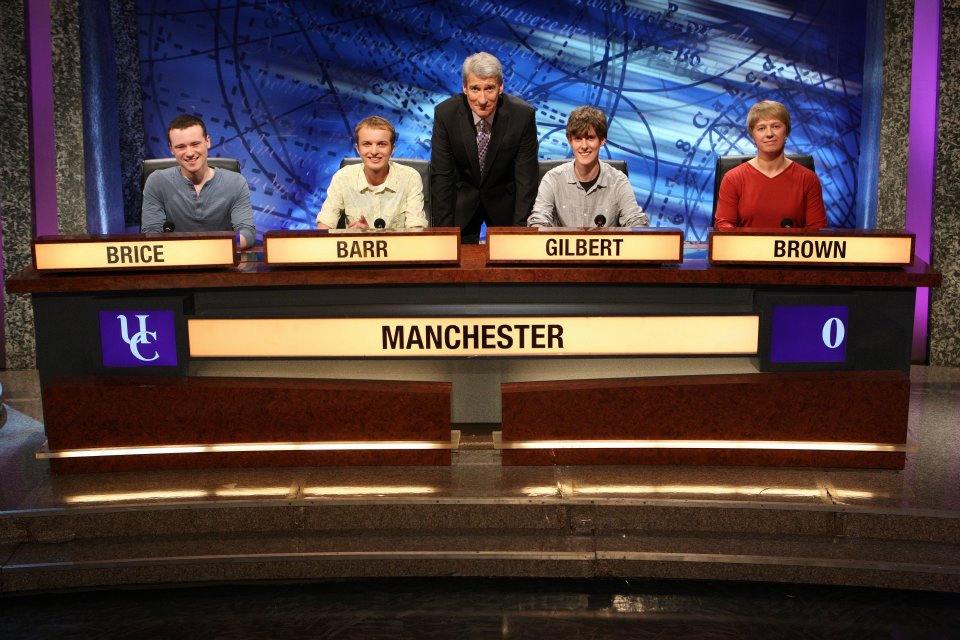 |
| 2013-2023 The 2013-4 series brought a further change, retaining a blue theme but replacing the backdrop with an abstract pattern. | 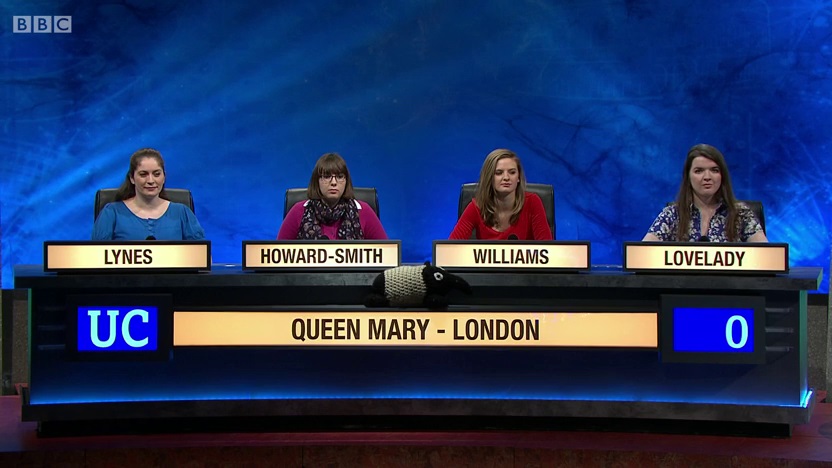 |
| 2023- Amol Rajan's arrival heralded a new set and though the backdrop featured a similar blue abstract pattern, new grey surrounds appeared with green strip lights. | 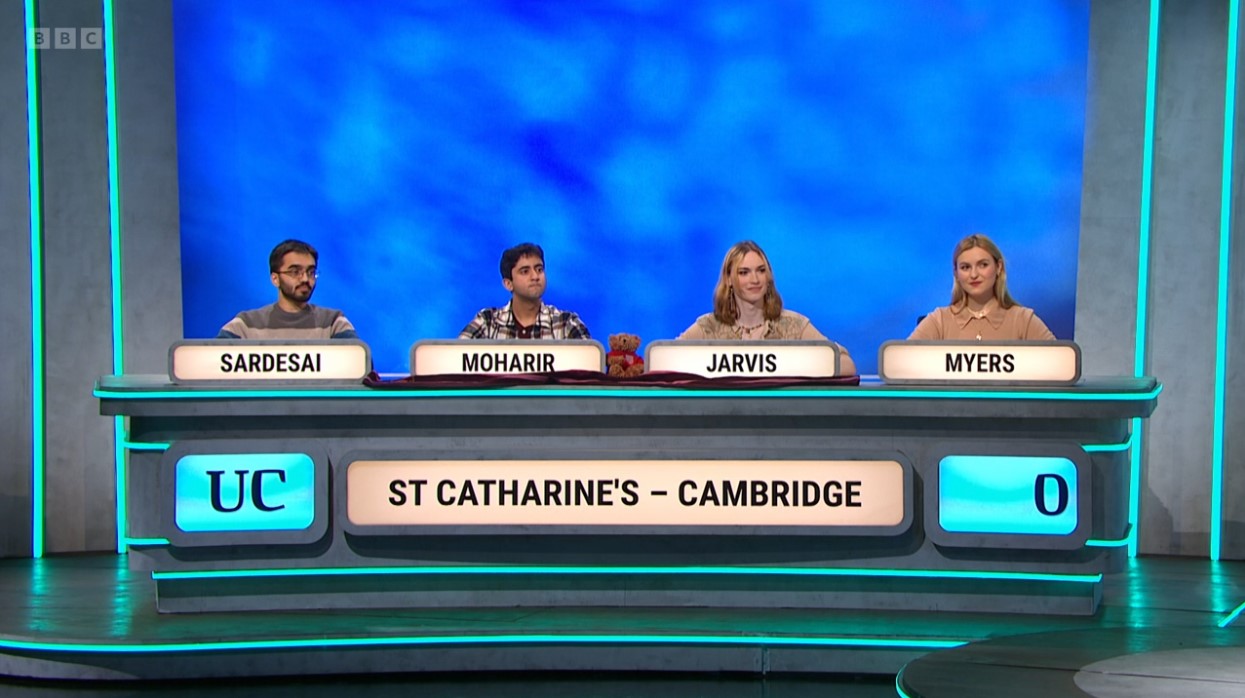 |